Prosopography
/tablet/<id>/prosopography — editorial accounts holding prosopographic permissions.
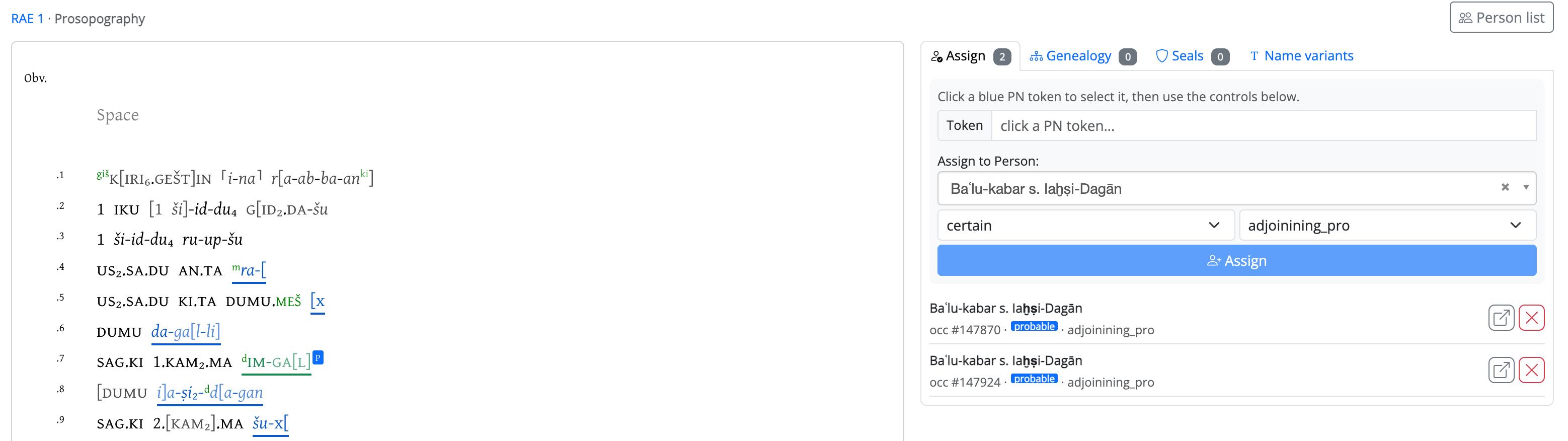
This mode reads the tablet with the personal names highlighted and lets you say, for each of them, which individual it refers to. It is the point where an onomastic fact — the token spells the name Aḫiu — becomes a historical one: this attestation of Aḫiu is the man who appears as a witness in three other Emar contracts.
The right-hand column has three tabs, each counting what is already on the tablet:
| Tab | Contents |
|---|---|
| Assign | the attestations already assigned, and the panel for assigning more |
| Family | the occurrence-level kinship relations recorded in Mark genealogies |
| Seals | the seal attestations recorded in Seals |
Each assignment carries a confidence — certain, probable, possible, uncertain — shown as a coloured badge. The uncertainty belongs to the link between the occurrence and the individual, never to the individual: a person is not "probable", an identification is.
Input form
Where the procedure is documented
Assigning occurrences, creating an individual, choosing the confidence level and the role played in the text are all part of the prosopographic workflow, which runs across the whole corpus rather than one tablet. It is documented in full, with its own reasoning, under:
Two prerequisites are worth repeating here, because they are the usual reason this mode looks empty:
- the name must be classified as a personal name in the transliteration. Only tokens marked as such are highlighted and assignable — see Edit tablet;
- the name must have been normalised to a name form in the Lemmatizer. Candidate occurrences are proposed to you through the name forms already attached to an individual, so a name that has never been normalised has nothing to be matched against.