Text Information
Provenience Map
| Loading cuneiform… |
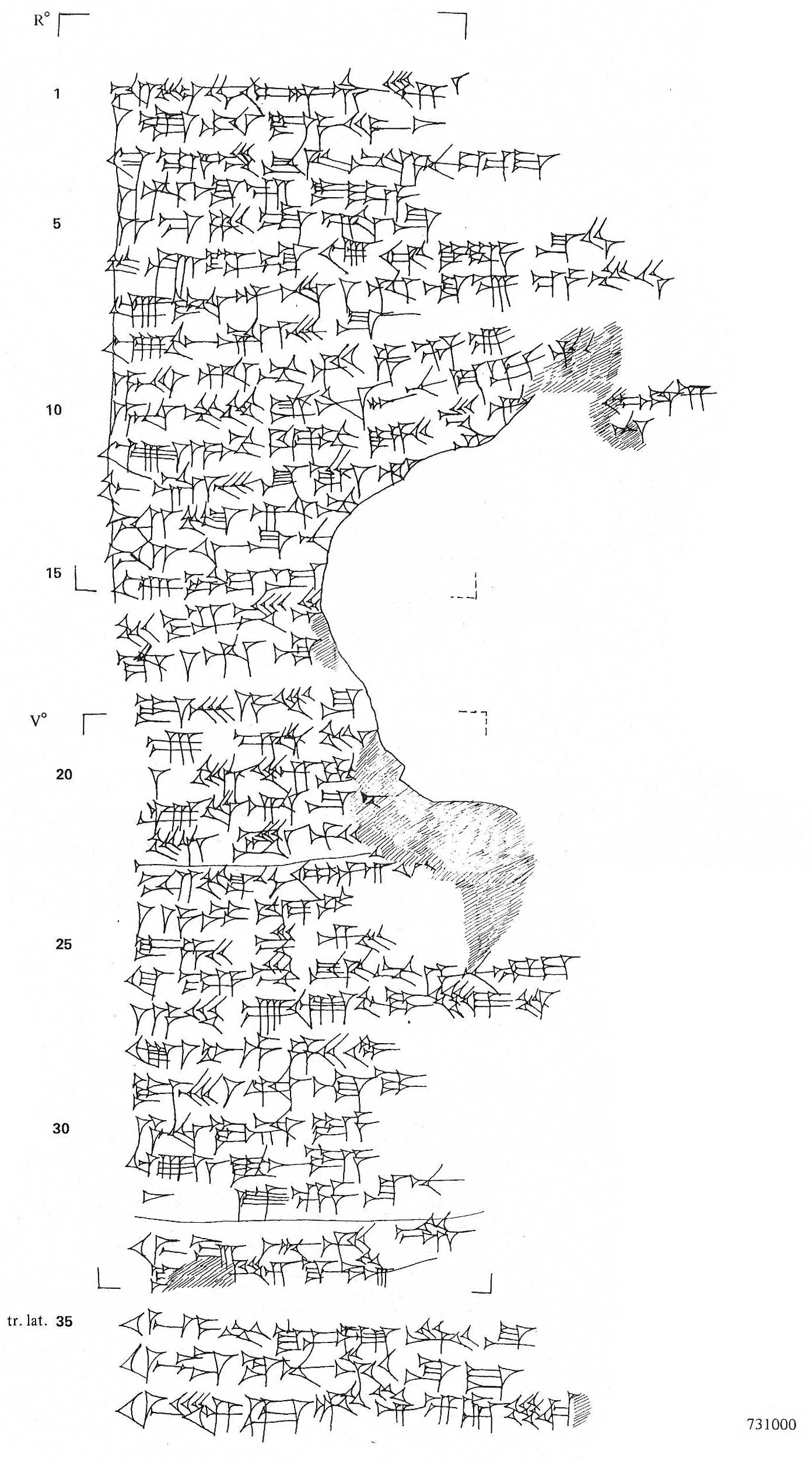
— Handcopy by Daniel Arnaud
ll. 1–3 On this day, Adda son of Awiru spoke as follows:
ll. 4–6 “Ḫulû (is) my son (but) his two sticks are broken and he is no longer my son.”
ll. 7–10 And now Ḫulû is dead, and his children were thrown out in the square in the year of war.
ll. 11–14 And (when) Abī-kāpī son of Ḫamṣu learned (about it), he lifted the children of Ḫulû son of Adda from the square.
ll. 15–22 If in the future the brother of Ḫulû wants to release his brother’s sons, he shall give 1000 (shekels) of silver for their release and take (them).
ll. 23–26 On this day Abī-kāpī son of Ḫamṣu spoke as follows:
ll. 27–32 “I established Aḫiu and Išarte and ʾAḫa-mi, sons of Ḫulû, as my son and my two daughters.”
General notes
Secondary Literature
- Review Durand, J.-M. (1990). review of ARNAUD, D., Recherches au Pays d’Aštata. Emar VI.3. Textes sumériens et accadiens. Texte, Paris (1986). Revue d’assyriologie et d’archéologie orientale, 84, 49–85. — 76
- Study Zaccagnini, C. (1995). War and Famine at Emar. Orientalia. Nuova Serie, 64, 92–109. — 102-103
- Study Tropper, J., & Vita, J.-P. (2004). Texte aus Emar. In B. Janowski & G. Wilhelm (Eds.), Texte aus der Umwelt des Alten Testaments, Neue Folge 1: Texte zum Rechts- und Wirtschaftsleben (pp. 146–162). — 147-148
- Study Bellotto, N. (2009). Le adozioni a Emar. — 147-148; 220-221
- Study Justel, J. J. (2014). Mujeres y derecho en el Próximo Oriente Antiguo. La presencia de mujeres en los textos jurídicos cuneiformes del segundo y primer milenios a. C.. — 92
- Study Yamada, M. (2014). The Broken Staffs: Disinheritance in Emar in the Light of the Laws of Ḫammurabi § 169 and the Nuzi Texts. Orient, 49, 171–185. — 174
- Study Fijałkowska, L. (2018). ‘I Was Swollen with Hunger and He Kept Me Alive’. The Imagery of the Legal Texts from Emar. In P. Attinger, A. Cavigneaux, C. Mittermayer, & M. Novák (Eds.), Text and Image. Proceedings of the 61e Rencontre Assyriologique Internationale, Geneva and Bern, 22–26 June 2015 (pp. 147–152). — 150
- Study Justel, D. (2018). Infancia y legalidad en el Próximo Oriente antiguo durante el Bronce Reciente (ca. 1500–1100 a. C.). — 35
- Study Viano, M. (2023). Debt and Indebtedness at Emar. De Gruyter. — 460-463
Commentary
- alt. rd. l. 9 : 76
- alt. rd. l. 11 : 76