The Document
Each document in the DAPCA has a stable, permanent URL that ensures long-term accessibility and reliable citation. Digital Object Identifiers (DOIs) are forthcoming for all entries, providing an additional layer of persistent identification that conforms to international standards for scholarly resource management.
Persistent identification and citation
These permanent identifiers facilitate accurate citation in academic publications and enable consistent reference to specific documents across different research contexts.
Documents can be accessed through two primary pathways:
- Direct access is available via the document's permanent URL, enabling immediate navigation to specific tablets when the identifier is known (e.g.,
https://dapca.cnr.it/tablet/33/view). - Alternatively, users can navigate through the comprehensive database interface - database -, which provides browsing, filtering, and search capabilities as described in Catalog, section X.X.
Each cuneiform document in the DAPCA repository is presented through a multi-layered framework designed to provide comprehensive access to both the physical artifact and its textual content.
General layout
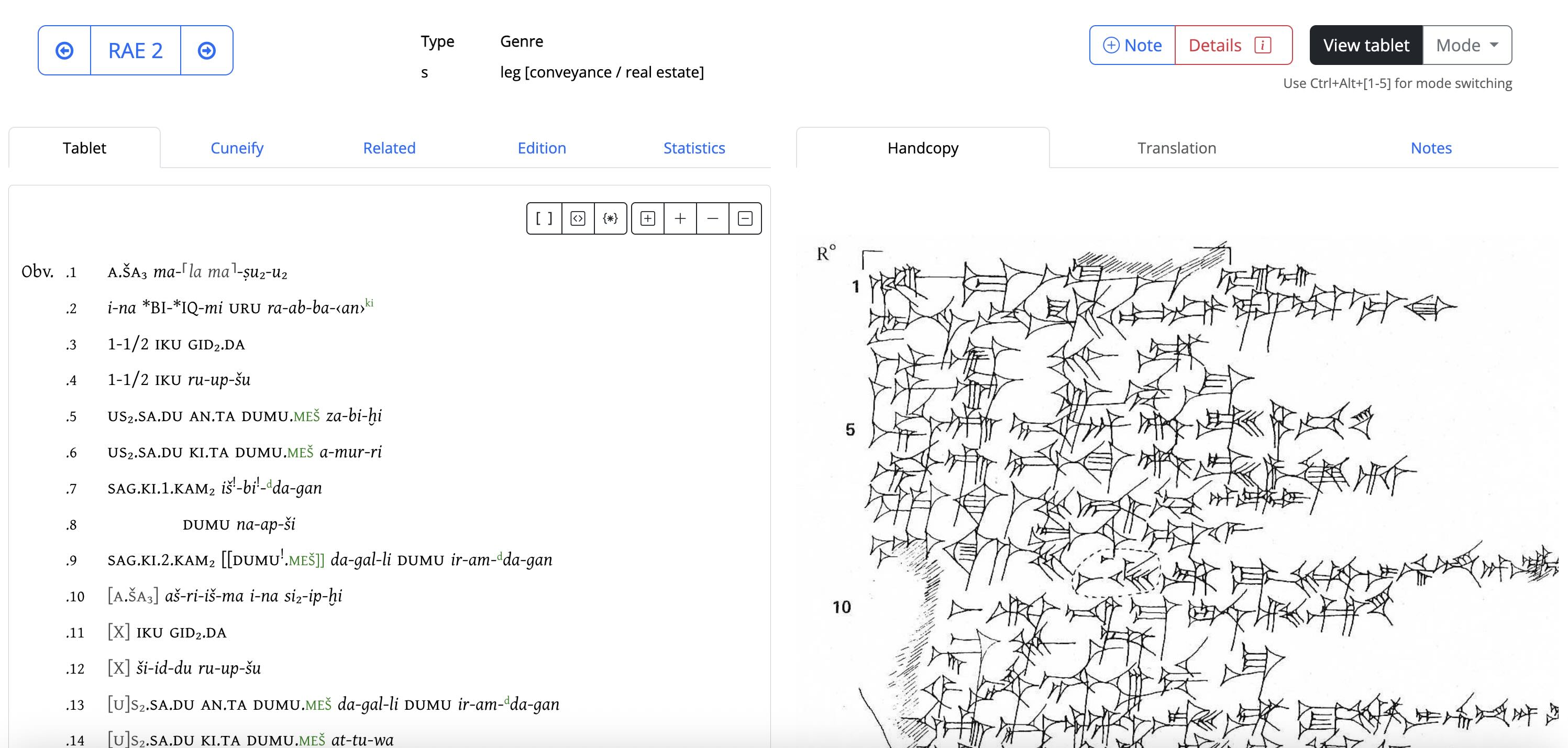 Fig. 1
Document details
In the upper part of the interface, the document's metadata is displayed, including its title, author, date, and provenance. This information is derived from the document's metadata, which is stored in a structured format that allows for easy access and manipulation.
In addition, a detail section ( Details ) is devoted to provide additional information about the tablet. For instace, the entire set of bibliographic references regarding both the publication history of the tablet itself (editions, studies, etc.) and additional materials such as handcopies, images, seals.
Document details
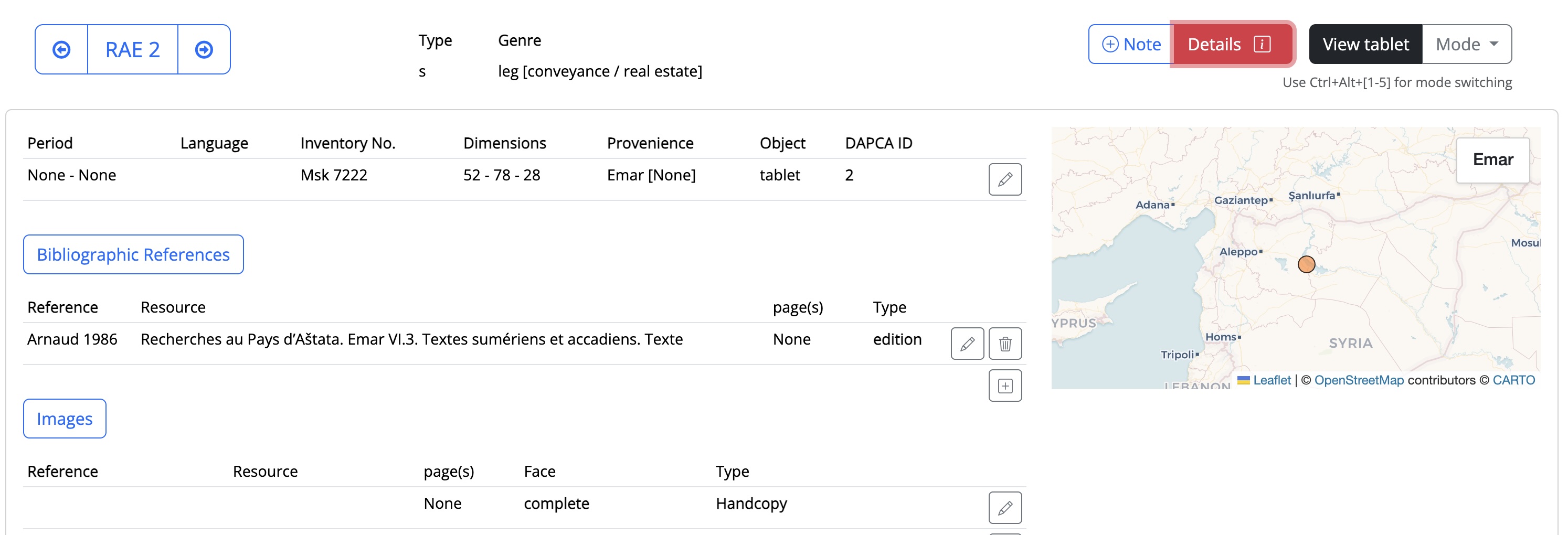 Fig. 2
General layout
As illustrated in the accompanying figure (Fig.1), the interface layout is organized into two primary sections: 1. a left-hand column and 2. a right-hand column. These sections are further designed to accommodate multiple layers of information, accessible through a tab-based navigation system. The purpose of this layout, which represents a significant departure from traditional paper-based editions, is to facilitate a continuous comparative analysis of the content accessible to the user.
By default, each document page opens displaying the transliterated text alongside its handcopy, where available.
In addition, the system attempts to synchronize line numbering between the two views, enabling users to move seamlessly between reading the transliteration and examining the corresponding portion of the tablet copy.
Synchronization Accuracy
The effectiveness of this synchronization varies depending on several factors. While alignment typically functions well with handcopies, users may need to adjust their workflow accordingly for documents where precise alignment proves difficult to maintain.
1. Left column
1.1. Transliteration (deafault)
The transliterations presented in DAPCA are systematically organized according to their original reference editions, preserving the scholarly lineage of each text. However, these transliterations have undergone comprehensive critical revision that integrates subsequent scholarly editions, incorporates insights from secondary literature, and reflects meticulous re-examination of the primary sources conducted by the DAPCA research team.
Hierarchical bibliographic organization
The platform implements a differentiated approach to bibliographic citation that distinguishes between document-level references and passage-specific references.
-
Document-level citations — such as editio princeps, subsequent editions, comprehensive discussions, or general treatments of the text — are consolidated in the "Details" section, providing users with immediate access to the complete publication history and scholarly reception of the document as a whole.
-
Conversely, passage-specific references — including commentary on individual lines, discussions of particular lexical items, or debates concerning specific textual restorations — are organized within the "Notes" tab in the right-hand column, positioned adjacent to the relevant portion of the transliteration. This hierarchical organization ensures that bibliographic information remains contextually appropriate: macro-level scholarship is accessible at the document level, while granular philological discussions are integrated directly into the line-by-line apparatus. Users thus encounter relevant bibliography at the appropriate scale of analysis, whether conducting broad surveys of a text's scholarly treatment or engaging with specific interpretive cruxes within the transliteration.
1.1.1. Semantic annotation and visual enhancement
The transliteration interface supports visual enrichment through a comprehensive system of semantic annotations. This annotation framework identifies and categorizes individual lexical units (tokens) according to an array of predetermined classes, including personal names (distinguished by gender), toponyms, theophoric elements, numerals, and other contextually significant ones (refer to [semantic annotation]).
Each semantic class is assigned a distinctive color code, creating a visual layer that enhances readability and facilitates rapid identification of specific word types within the text.
Semantic annotation system
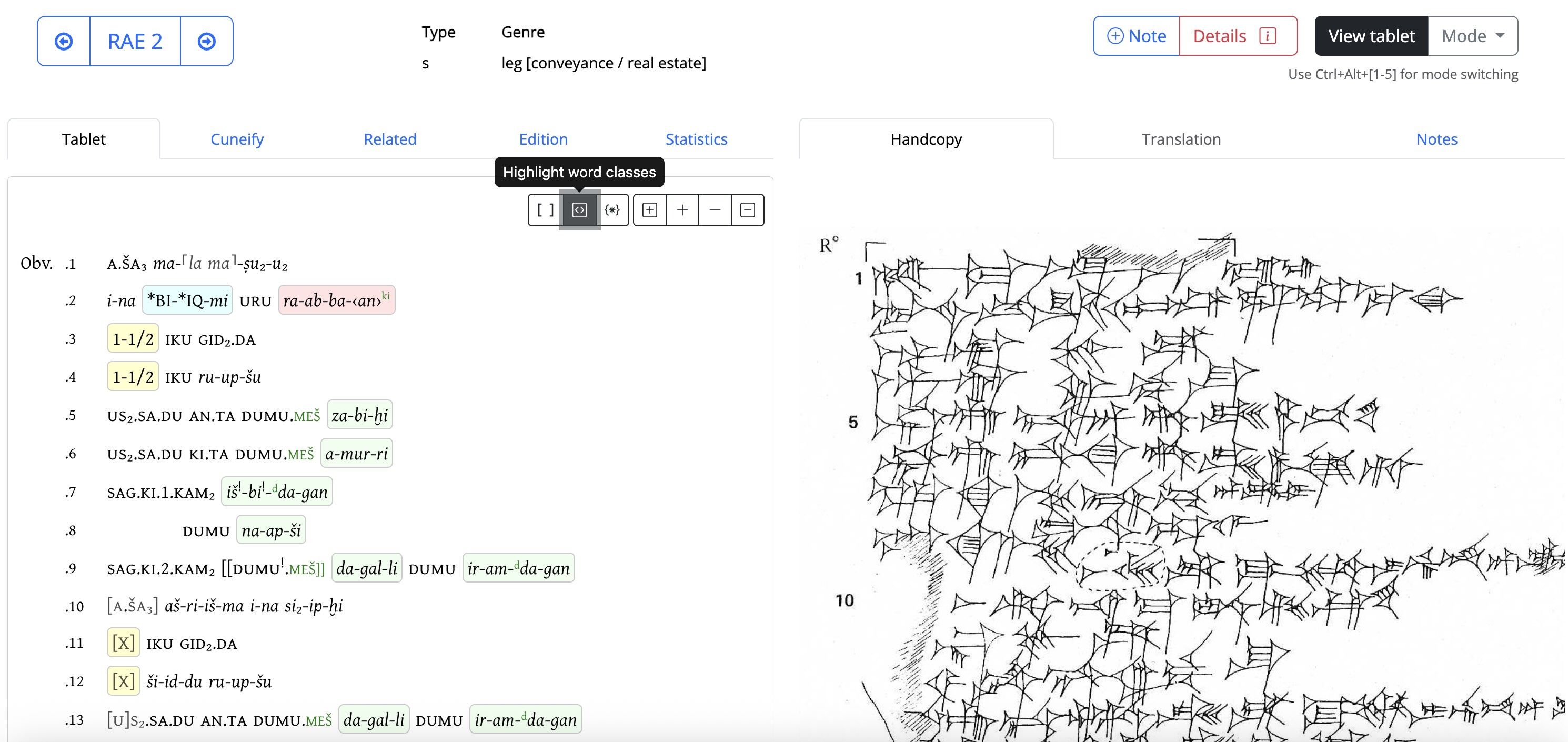
Enhanced analytical capabilities
The semantic annotation system serves dual purposes: it improves the immediate visual accessibility of textual content for human readers, while simultaneously structuring the data in ways that support sophisticated computational queries. Users can leverage these annotations to construct targeted searches (e.g., retrieving all texts mentioning a particular deity or containing references to specific geographic locations), to generate statistical analyses of name distributions, or to examine the co-occurrence patterns of different semantic categories within defined documentary contexts. The annotation layer thus functions as both a reading aid and an analytical infrastructure, bridging traditional philological practice with digital humanities methodologies.
1.1.2. Word level information
The platform implements a lexical annotation system that transforms each word in the transliteration into an actionable interface element. Users can select any term to visualize a detailed information panel that presents multi-layered data organized across three analytical levels.
Word-level information
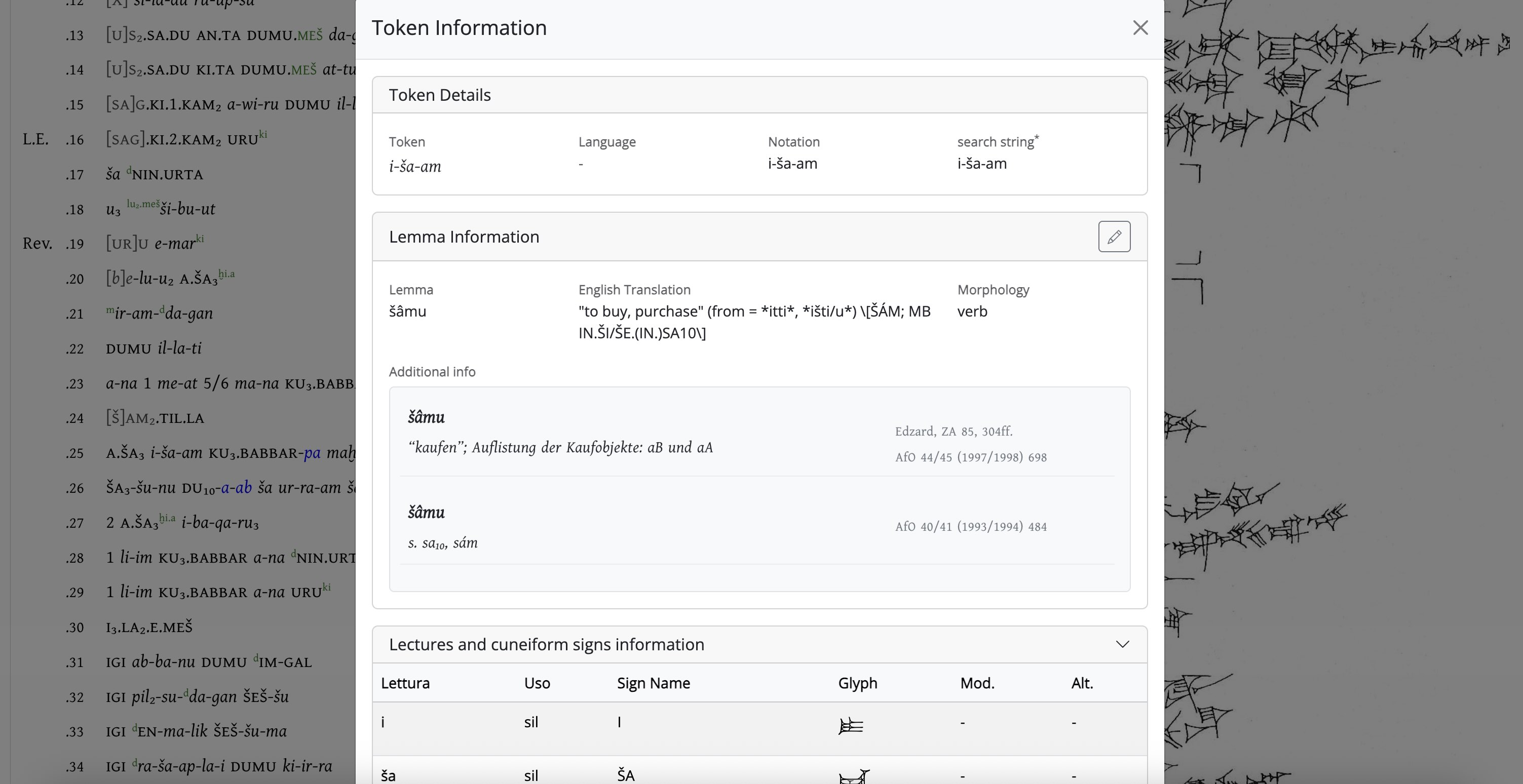
Token-level information. The panel displays data specific to the individual word form as it appears in the document, including its precise graphemic representation and optimal search strategies for retrieval within DAPCA's search engine.
Lemmatic analysis. The system provides lexicographic information organized around the dictionary headword (lemma), including primary semantic values, basic morphological classification, and curated bibliographic references to scholarly discussions of the term's interpretation. These references encompass the range of scholarly opinion regarding the lexeme's meaning and usage, independent of the specific contextual application in the document under examination.
Sign-level decomposition. Each word form is parsed into its constituent cuneiform signs, with detailed information provided for each graphemic component. This includes the actual reading and usage, sign names, and Unicode glyphs where available.
Acknowledgment
The development of this functionality has benefited significantly from partner with the electronic Babylonian Library (eBL) project, whose pioneering work ...
1.2. Photograph
When photographic documentation is available, the interface positions photographs in the left column to facilitate direct visual comparison with handcopy drawings displayed in the right column. This side-by-side arrangement enables users to assess the interpretive accuracy of published hand copies, to evaluate how graphic conventions translate three-dimensional tablet surfaces into two-dimensional representations, and to identify features that may be visible in photographs but omitted or differently rendered in hand copies. The comparative layout supports critical engagement with the mediated nature of cuneiform documentation, acknowledging that handcopies constitute interpretive representations of the source material. Users can thus develop more nuanced assessments of textual readings by triangulating between the original artifact (as captured photographically), its scholarly graphic representation (the handcopy), and the transliteration.
When multiple graphic resources are available for a single document users can toggle between available images without leaving the document view.
1.3. "Cuneifier"
The cuneiform rendering interface provides users with the capability to transform transliterated texts into cuneiform script through Unicode-compliant fonts designed to represent the graphemic systems of ancient Western Asian writing traditions. This experimental feature addresses a longstanding challenge in digital cuneiform studies: the tension between the standardized nature of transliteration systems and the visual complexity of the original writing medium.
However, at present, this functionality serves principally to enhance accessibility for non-specialist audiences and students by providing visual approximations of cuneiform writing that complement transliterations and translations.
Font implementation strategy
The system employs a two-tiered font architecture to balance paleographic accuracy with comprehensive sign coverage.
-
The primary rendering engine utilizes Ullikummi (refer to Ullikummi font documentation), a font that most closely approximates the paleographic characteristics required by the Late Bronze Age peripheral archives, despite having been designed specifically for Hittite cuneiform.
-
Where Ullikummi lacks coverage for particular signs or sign variants, the system falls back to Noto Sans Cuneiform (refer to Noto Sans Cuneiform font documentation), a font with broader Unicode support but less paleographic specificity. This hierarchical approach ensures maximum character availability while maintaining visual fidelity where possible.
Current limitations and developmental trajectory: As an experimental feature, the cuneiform rendering system operates within acknowledged constraints. Most significantly, no single Unicode font currently exists that can adequately represent the full range of sign forms attested across the diverse archival traditions encompassed by DAPCA — each of which exhibits distinct paleographic conventions shaped by regional scribal practices, chronological development, and local writing traditions.
Additionally, numerical notations are not currently transformed into their cuneiform equivalents, remaining in transliterated form to ensure unambiguous interpretation.
1.4. Related documents
forthcoming
This functionality remains under active development and is not yet fully implemented across the platform.
This interface is designed to illuminate the multidimensional connections that situate individual documents within the broader documentary ecosystem of DAPCA. The system may identify and visualize connections based on diverse relational criteria including shared documentary typology (such as purchase contracts, loan agreements, or administrative receipts), common scribal attribution, prosopographic overlap (mentions of the same individuals across documents), and other contextual affinities. This approach enables users to trace patterns of documentary practice, reconstruct social networks, and identify clusters of related materials that may reflect specific administrative procedures or archival formation processes.
2. Right column
2.1. Handcopy (deafault)
The platform provides access to hand-copied representations of cuneiform documents, which constitute an essential component of the scholarly apparatus for epigraphic analysis. These handcopies have been digitized from authoritative reference editions through systematic scanning procedures.
When multiple graphic resources are available for a single document users can toggle between available images without leaving the document view.
Attribution and intellectual property: Each handcopy image is accompanied by complete bibliographic citations displayed directly beneath the image, ensuring proper attribution to the original draftsperson and publication. This practice acknowledges the scholarly labor invested in creating these specialized technical drawings and maintains compliance with academic citation standards.
Resolution policy and copyright distinction: To maintain a clear distinction from the original published works while enabling meaningful scholarly consultation, handcopies have been acquired at a resolution optimized for on-screen display but intentionally insufficient for high-quality print reproduction. This deliberate technical limitation serves multiple purposes: it respects the intellectual property rights of original publishers and authors, discourages unauthorized reproduction of copyrighted materials, and encourages users to consult original publications for detailed paleographic analysis and authoritative citation.
2.2. Translation
The platform provides English translations for all documents in the corpus, designed to facilitate access for diverse scholarly audiences and non-specialist users. These translations represent a systematic effort to present the documentary content in a linguistically accessible format while maintaining fidelity to the source material.
Translation
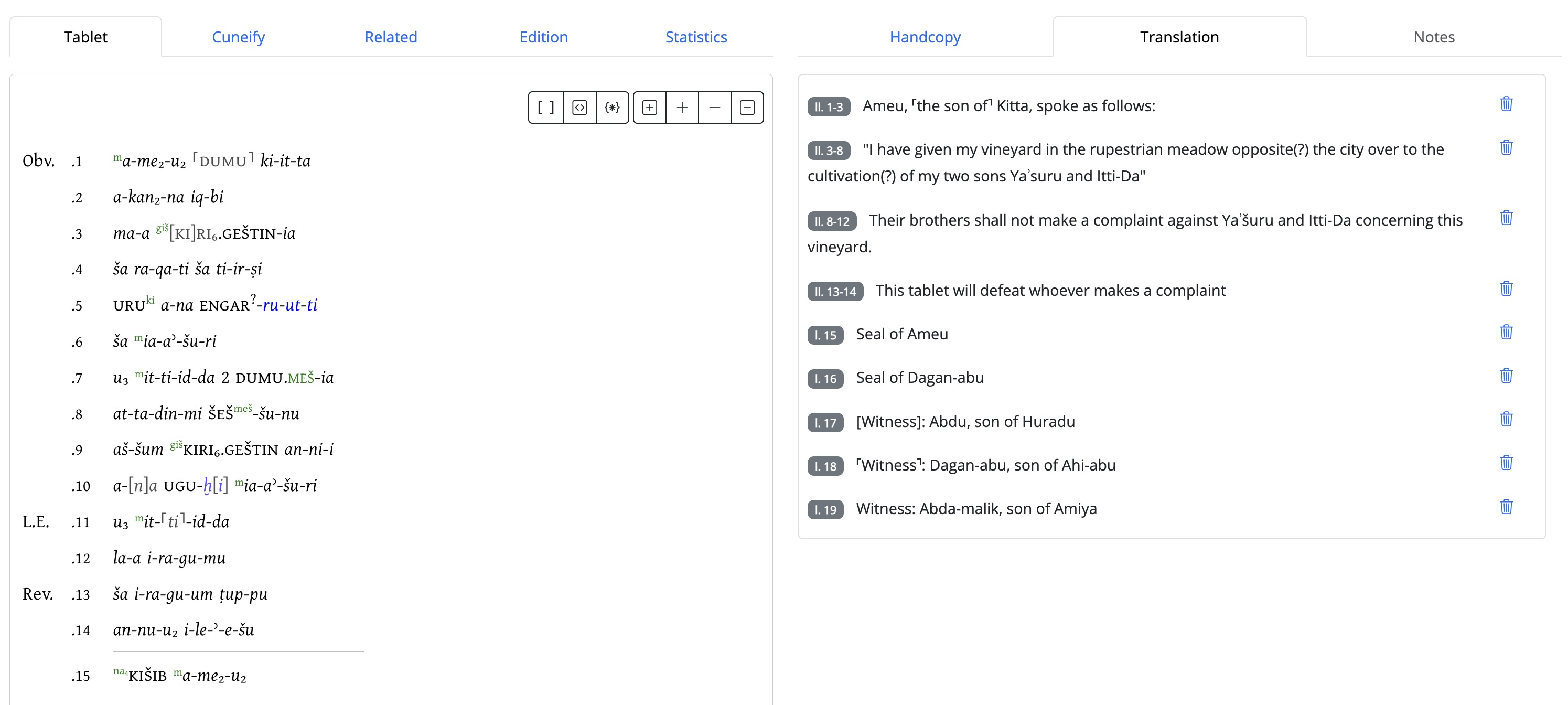
Translation methodology and source materials: English translations have been prepared primarily from original scholarly editions, preserving the interpretive work of the editiones principes wherever possible. In cases where original editions were published in languages other than English, translations have been produced from these source languages with appropriate adaptation. Where DAPCA's revised transliterations (see section 1.1) diverge from those in original publications—whether due to collation against primary documentation, advances in lexicographic knowledge, or reinterpretation of damaged passages—the English translations have been systematically updated to reflect these textual modifications, ensuring consistency between the transliteration and translation layers of the digital text.
Editorial intervention and standardization: The translation process has involved careful editorial work to harmonize terminological choices, resolve ambiguities in earlier translations, and adapt formatting conventions to the digital environment. This editorial intervention aims to balance scholarly precision with readability, providing translations that serve both as research tools for specialists familiar with the source languages and as entry points for researchers from adjacent disciplines or students encountering cuneiform documentation for the first time.
2.3. Notes
The annotation interface provides a dedicated section for displaying scholarly commentary and interpretive apparatus linked to specific textual passages (refer to XXX). This feature addresses the need to preserve and present the layered interpretive work that accumulates around cuneiform texts through successive stages of scholarly engagement.
Annotations and Passage-Specific Commentary
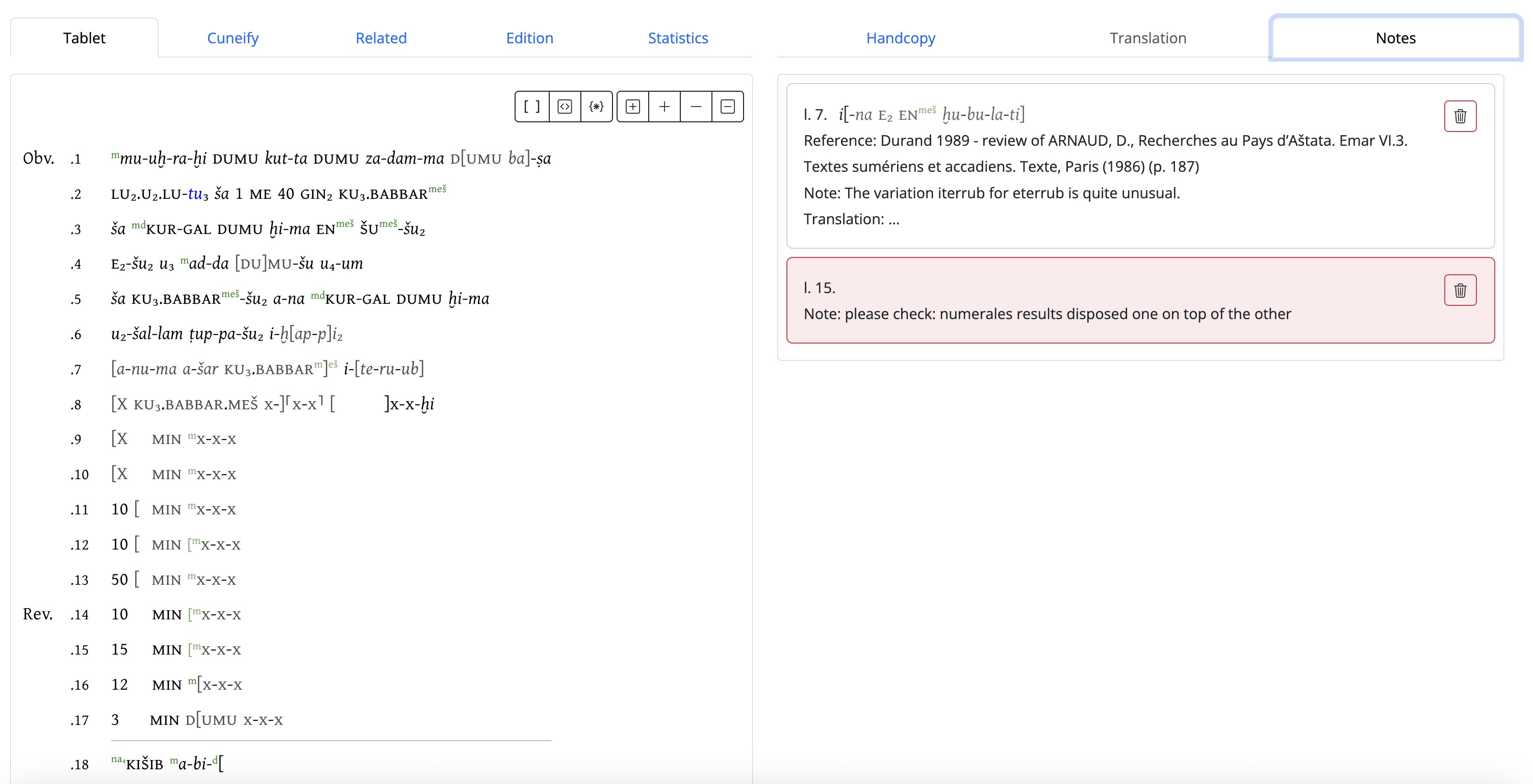
Structured annotation types: The system may accommodate multiple categories of annotations, ranging from philological commentary to historical-contextual observations, and discussions of textual restorations as well as alternative readings.
Passage-level bibliographic integration: Each annotation may be systematically linked to relevant bibliographic references through the platform's integrated citation management system (see section XXX). These passage-specific references differ from general document bibliography by pointing to discussions of particular phrases, words, or interpretive cruxes within secondary literature. This granular bibliographic apparatus enables users to trace scholarly debates concerning specific textual features and to engage with the interpretive history of individual passages without consulting dispersed publications.
Presentation architecture: The annotation section maintains a persistent presence within the document view, ensuring that scholarly commentary remains accessible alongside the transliteration, translation, and other documentary layers. This integrated presentation model reflects the principle that cuneiform texts are fundamentally mediated objects whose meaning emerges through scholarly interpretation, and that digital presentation should make this interpretive labor visible rather than concealing it beneath an illusion of textual transparency.